


Race & training at a glance
- 2:55:10 — Chip time
- 45 — Age on race day
- 4:08/km — Average pace
- −1:55 — Negative split
- 111 km — Peak training week
- 42.4 km — Longest training run
- 1,232 km — Total training distance
- 14 weeks — Training block
Three hours is the barrier that lives rent-free in the head of every serious recreational marathon runner. The pace it asks for — 4:15 per kilometre, 6:51 per mile — does not give you a comfortable mile anywhere. It gives you 26.2 miles of staying on it. And at 45, the margin gets a little thinner every year you leave it.
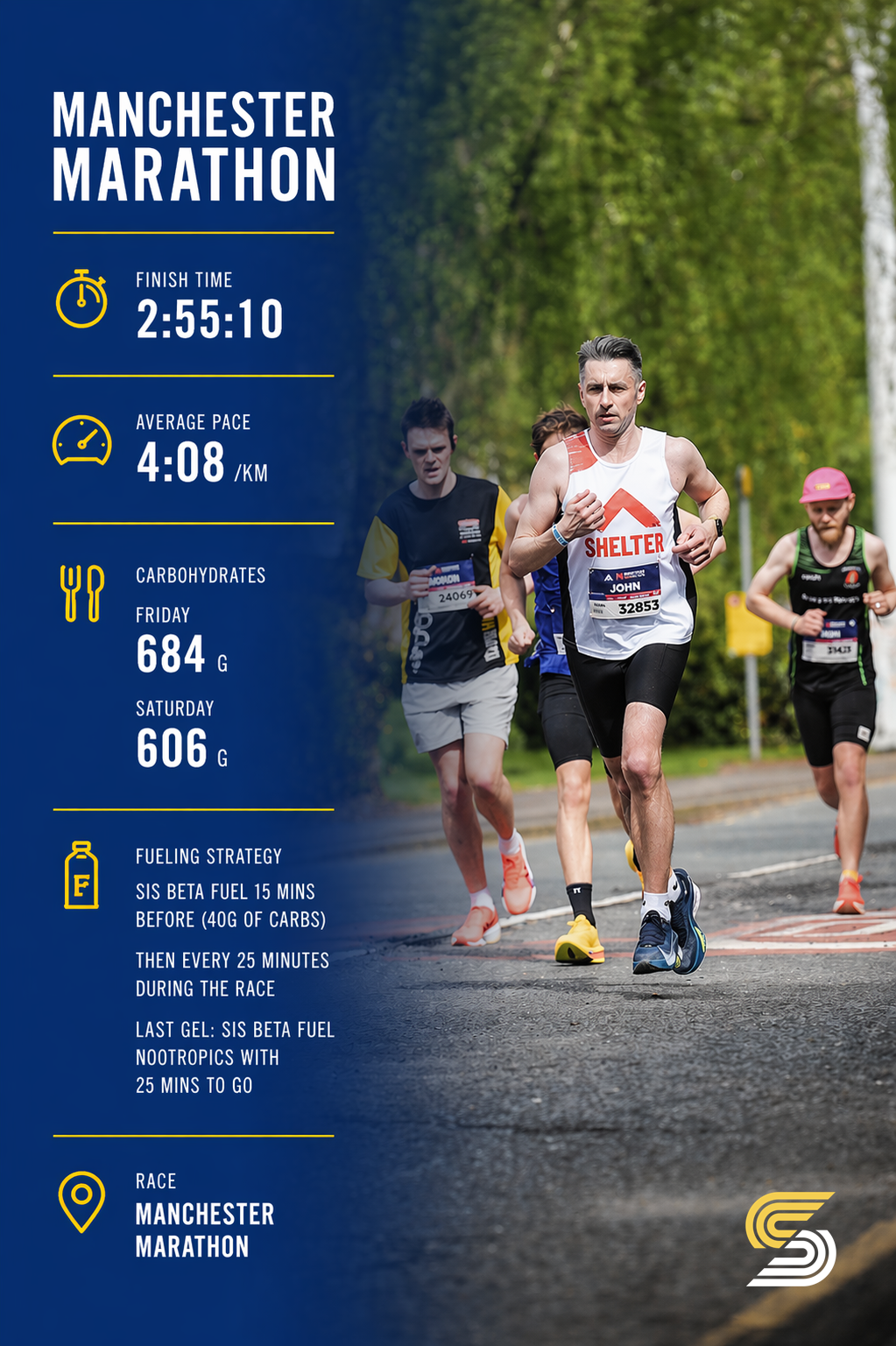
This April I crossed the line at the adidas Manchester Marathon in 2:55:10. Here is how the training was built, and how the fuelling held it together.
Why structure matters more after 40
Masters runners recover more slowly and respond far better to consistency than to spikes in volume. The block that worked for me peaked at 111km in a single week, but the peak is not the interesting number. The architecture underneath it is.
Every week had the same skeleton for fourteen weeks: Monday recovery, Tuesday speed, Wednesday strength plus an easy run, Thursday easy, Friday rest, Saturday a threshold effort built around the local parkrun, Sunday long. What went into each slot changed as the block progressed. The shape of the week never did.
That predictability is the whole trick. It is what lets you string fourteen productive weeks together without breaking — which, at 45, is the genuinely hard part of the exercise.
From 1 January to race day the block totalled 1,232km (765 miles), including eleven long runs of 25km or more and a 42.4km marathon simulation six weeks out.
Planning and measuring the block in Structur
Structur syncs directly with Garmin Connect, so every session lands in the platform without being touched. The plan and the actual data sit side by side, which means the Sunday evening question — did this week go the way it was supposed to? — gets answered with numbers rather than a feeling.
The most useful thing it surfaced was not pace. It was aerobic efficiency on easy runs: pace divided by heart rate, where lower is better. That figure fell steadily across the fourteen weeks, and it is the cleanest signal you can get that the engine is genuinely improving rather than that you are simply suffering harder. By the peak of the block my easy runs were 15 to 20 seconds per kilometre quicker at the same heart rate as in early February.
The three sessions that built the fitness
Three workouts did the heavy lifting.
The 42.4km long run on 8 March, six weeks out, at 4:45/km. Three hours and twenty-two minutes on the feet, and the considerable psychological benefit of having already covered the distance once.
The 30.6km long run on 22 March at 4:15/km. Goal marathon pace, heart rate sitting at 166bpm — comfortably below my lab-tested lactate threshold of 179bpm. Of everything in the block, this was the single best predictor that race day would hold.
Tuesday's 8 × 1km repeats at 3:32/km. Quicker than lab threshold pace, building the speed reserve that makes marathon pace feel like cruising rather than working.
Carb loading: what actually went in
Carb loading is among the best-evidenced practices in endurance sport and among the most poorly executed. The target is 8 to 12 grams of carbohydrate per kilogram of bodyweight per day for the two days before the race. For a 70kg runner that is 560 to 840 grams a day. Almost everybody undershoots it, usually by a wide margin.
Two days out from Manchester I logged 684g of carbohydrate: porridge, mac and cheese, salmon with rice, custard creams, rice cakes, and a litre of chocolate milk. 4,418 calories in total.
The day before: 607g. Caramel waffles, a margherita pizza, more rice with salmon, orange juice, tortilla chips, fizzy laces and Coca-Cola. 3,717 calories.

It is intentionally high in carbohydrate and intentionally low in fibre, because fibre is still sitting in your gut on race morning. The boring foods are doing the real work here: white rice, white bread and sweets exist in this plan to fill glycogen stores to the brim. You will feel slightly bloated. That is the point. You are carrying fuel.
In-race fuelling: one gel every 25 minutes
The in-race target is 60 to 90 grams of carbohydrate per hour, and the research increasingly supports the top of that range.
My strategy was simple and, more importantly, rehearsed: one SiS Beta Fuel gel — 40g of carbohydrate — fifteen minutes before the start, then one every 25 minutes throughout. Sips of water at every aid station, never a full cup, just enough to wash the gel down.
That worked out at roughly seven gels across 2:55, around 280g of carbohydrate, or 95g an hour — at the upper end of what most runners can absorb. Beta Fuel uses a 1:0.8 ratio of maltodextrin to fructose, and the reason that matters is that glucose and fructose cross the intestinal wall through different transporters. Combining them lets you take on more per hour before the gut objects.
Practising the exact protocol is not optional. Every long run from 8 March onwards used the same gel, the same timing and the same approach to water. Race day was a rehearsal, not an experiment.
The race: a negative split built on data, not bravery
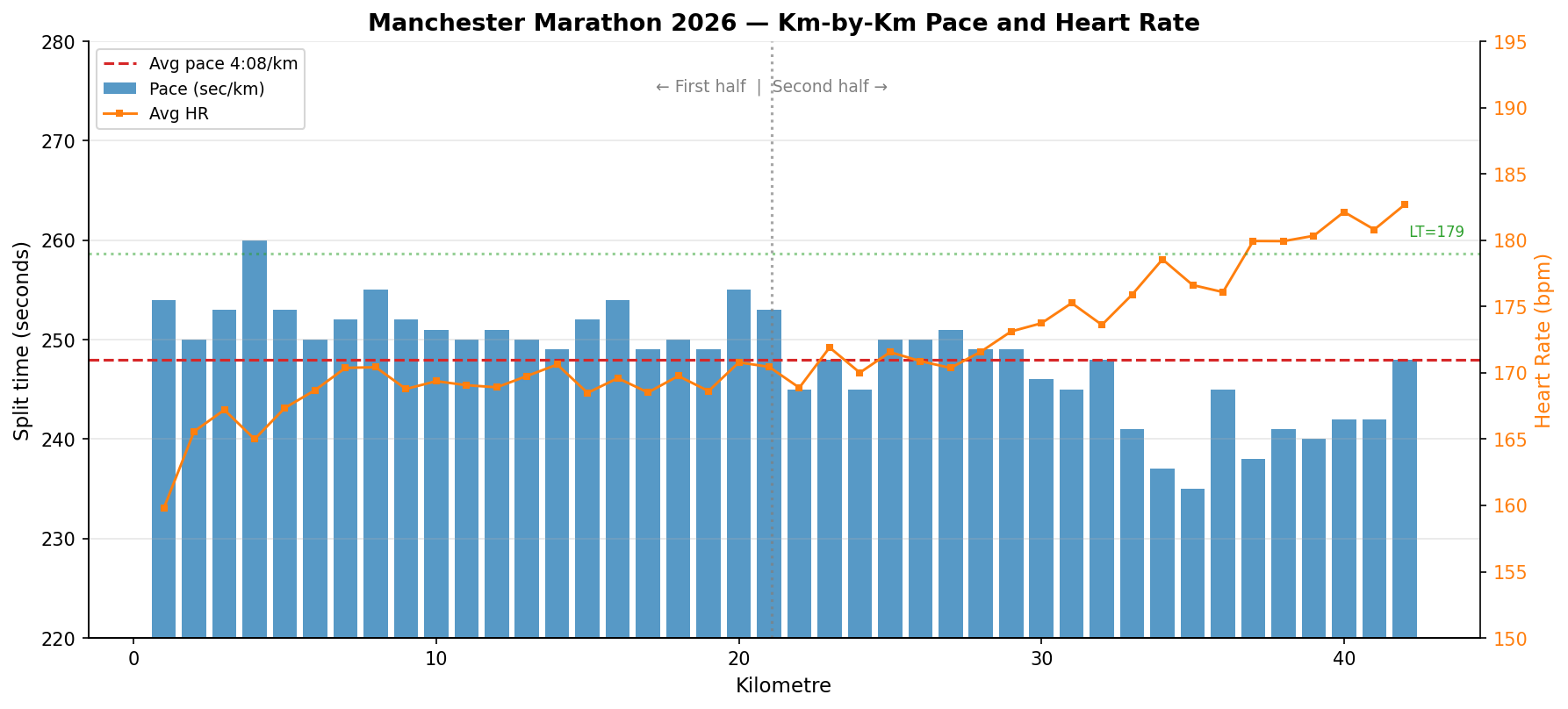
It played out cleanly. First half in 1:28:35, second half in 1:26:40 — a negative split of 1 minute 55. The quickest kilometre of the whole marathon was km 35, in 3:55.
The training data had been saying this was on for weeks. The only discipline required on the day was believing it, and not going through the first kilometre at 4:02 when 4:10 was the correct answer. Average heart rate for the race was 172bpm, below threshold: the marker of an effort that was paced rather than survived.
What sub-3 at 45 actually takes
Structure, first. A plan you can follow, synced to something that tells you honestly whether you are following it. Long runs, plenty of them, including one close to the distance. Specific sessions at specific paces, repeated week after week. A carb load that feels excessive and is in fact exactly what the evidence asks for. And a fuelling strategy rehearsed so often that race day becomes the easy part.
Age is a factor. It is not the limiting one. Build the plan, watch the data, eat the carbohydrate, take the gels, and trust the work.
Structur syncs with Garmin Connect to plan, track and analyse every session of your training block — so you know whether you are genuinely on for your goal time, rather than hoping.