
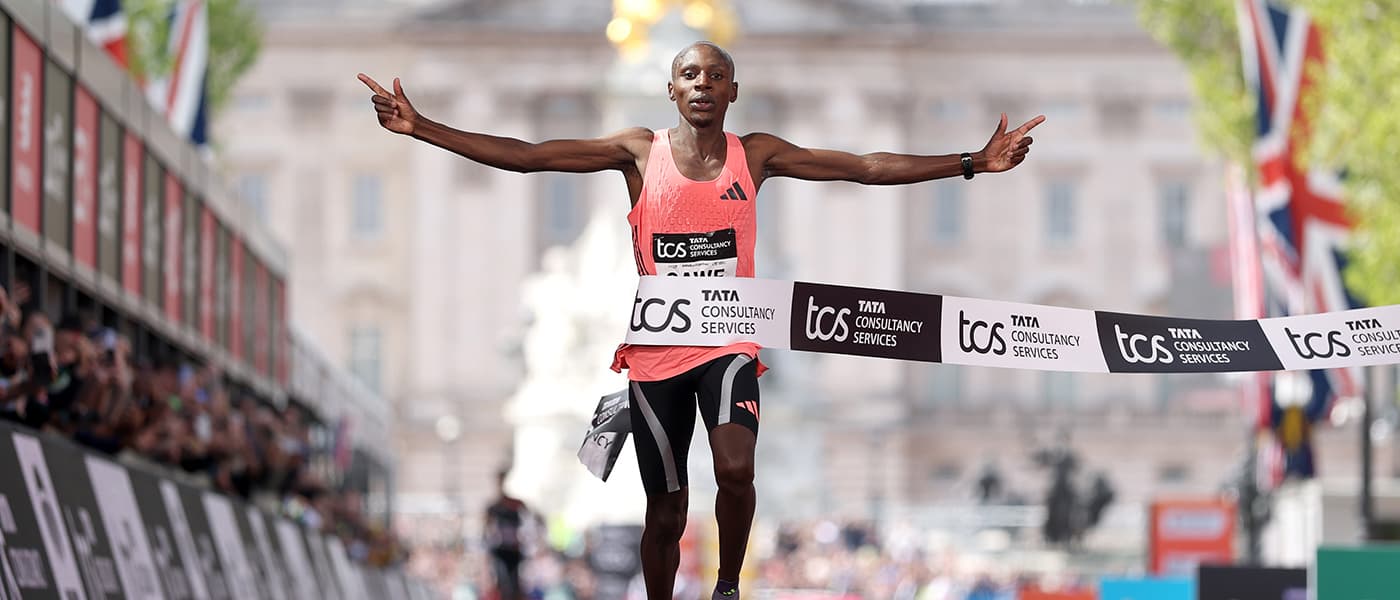

For years the two-hour marathon sat in the same category as the four-minute mile before 1954: close enough to picture, far enough away to feel untouchable. Even after Eliud Kipchoge ran 1:59:40 in Vienna in 2019, there was always an asterisk. It was an extraordinary run, but it was staged — rotating pacemakers, a car in front, a course chosen for the job — and never eligible as a record.
On Sunday in London, the asterisk went.
Kenya's Sabastian Sawe became the first athlete in history to run under two hours in an official marathon, crossing the line in 1:59:30. Remarkably, he was not alone: Ethiopia's Yomif Kejelcha also dipped under in 1:59:41, and Jacob Kiplimo ran 2:00:28, quicker than the previous world record.
Watching it live, it felt faintly unreal. The pace from the gun looked aggressive without ever looking reckless. The lead group settled quickly, the rhythm stayed smooth, and for long stretches the clock seemed almost to hang still. The impossible gradually turned into the inevitable, and by the final 10 kilometres it was obvious what was happening.
How Sawe made history
What made the run remarkable was not only the speed but the control. There was no blow-up and no scramble for survival in the closing miles. Sawe looked composed almost the whole way, which tells you more about the level the event has reached than the time alone does.
To appreciate the scale of it: breaking two hours requires averaging around 4 minutes 34 seconds per mile for the entire 26.2. Not for one mile, not for a 5K — for two straight hours. Most club runners could not hold that pace for a single lap of a track. Sawe held it through the streets of London, around corners, across changing road surfaces, in front of crowds, under the pressure of a championship-standard field.
The training behind it
The work required is difficult to hold in your head. Reports after the race suggested Sawe had been running up to 150 miles a week. That volume is not unusual at the elite level; what separates athletes like him is how the mileage is combined with intensity, recovery and consistency sustained over years rather than months.
Elite marathon training is also less relentless than people assume. A typical week for a world-class marathoner is built around two key sessions and a long run, with a great deal of comparatively easy aerobic running filling the rest. The object is an engine that can hold high speeds efficiently, not a week that hurts every day.
The clearest difference between elite runners and the rest of us is economy. Elite marathoners waste almost nothing. The stride is refined, the cadence is consistent, and the capacity to stay relaxed at absurd paces is the product of years at altitude, enormous aerobic conditioning and a deep understanding of pacing. Watch Sawe over the final miles and his form barely changes.
The mental side
There is a psychological dimension to a performance like this that tends to get overlooked. The marathon is brutally mental. Once glycogen starts to fall away and fatigue builds late in the race, every small weakness is exposed, and the athlete has to manage discomfort, doubt and decision-making while still running close to maximum output. Breaking two hours took more than fitness. It took complete belief that the number was possible.
Fuelling, and how it changed the event
Fuelling played an enormous part. Marathon performance has shifted dramatically over the last decade because athletes now understand carbohydrate intake far better than they did. Elite runners take on significantly more during a race than previous generations thought feasible. Sawe reportedly used Maurten gels, alongside a fuelling strategy rehearsed thoroughly in training.
This matters because the marathon is fundamentally an energy management problem. The body stores a finite amount of glycogen, and once it runs out, pace collapses quickly. Coaches and sports nutrition companies have spent years refining protocols to push that moment as far back as possible.
Today's elite athletes train their guts as seriously as their legs. Many now take 80 to 120 grams of carbohydrate an hour during a race. Ten years ago that would have sounded excessive; it is now standard at the highest level. Combine it with modern training methods and current shoe technology and the ceiling on what is achievable has moved.
The shoes
The shoes will inevitably become part of the conversation again. Sawe wore the latest generation of adidas racing shoes — lighter, more responsive and more efficient than anything available even a decade ago.
Some argue the technology has distorted the sport. Others hold that innovation has always been part of athletic progress. The truth probably sits between the two. Technology alone cannot produce a sub-two hour marathon, or thousands of runners would already be running one. But modern shoes do reduce energy loss and improve running economy by a small, meaningful margin — and at this level, small margins rewrite records.
What it means from here
It would be unfair to reduce Sunday to equipment. What Sawe did was, in the end, human.
The marathon holds a peculiar place in sport because it represents suffering in a fairly pure form. There are no shortcuts across 26.2 miles, and every mistake is eventually punished. That is why the moment travelled well beyond athletics: people who do not follow running understood immediately what they were watching. The two-hour barrier had become symbolic — the outer edge of endurance performance, argued over endlessly online, in coaching circles and in the research.
It has gone. And once a barrier goes, sport tends to move quickly. Bannister's four-minute mile was thought impossible until it wasn't, and others followed within a few years. The same will very likely happen here. More athletes will now believe the time is available because they have seen it done in a real race. Coaches will adjust pacing strategies, brands will keep innovating, and training systems will evolve again. What felt impossible last week suddenly looks reachable — and that may be the lasting legacy of this London Marathon.
Why it matters to the rest of us
For recreational runners the effect is different, but it is not nothing.
Almost nobody reading about Sawe is chasing two hours. Most are chasing four, or three and a half, or simply the finish of a first marathon. Moments like this still matter, because they are a reminder of why the event holds people the way it does. The marathon is one of the very few sports where professionals and amateurs share the same course, the same distance and the same problem on the same morning.
In London on Sunday, tens of thousands of runners lined up with entirely different goals. Some were chasing records. Others were running for a charity, for a family member, for their own health, or to prove something to themselves. That is what makes the distance what it is.
And on one extraordinary morning, the sport took another very large step forward. The sub-two hour marathon is no longer a theory. It is a result.